


The Leas and The Battle of Galveston
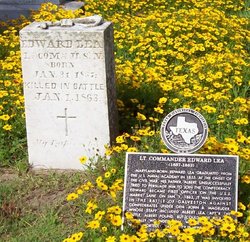 A small unassuming grave marker stands in the Trinity Episcopal Cemetery of Galveston. Though simple in design, it marks a New Year's Day that encompasses the tragedy of the War Between the States - the day a Confederate officer embraced a dying Union officer, his own son. Edward Lea was an 1855 graduate of the U.S. Naval Academy and rose to the rank of Lieutenant Commander. Edward's father, Albert Miller Lea (a West Point graduate and engineer), moved to Texas in the mid-1850s. In March 1861, just one month before the Civil War began, Albert applied for a Confederate commission. He wrote a letter to Edward, then 26 years old, advising him to follow his conscience when he made the decision regarding which side of the conflict to support. He added an ominous warning: "If you decide to fight for the Old Flag, it is not likely that we will meet again, except face to face on the battlefield." Edward chose loyalty to the Union. His ship, the U.S.S. Harriet Lane, was part of the Union fleet which captured Galveston Island in October 1862 and occupied its harbor. Ironically, his father Albert was on the staff of General Magruder as the Confederates planned to recapture Galveston Island. On 1 January 1863 a severe battle ensued. The Harriet Lane was rammed, and Confederate troops overran the vessel. Albert boarded the ship and found Edward had been shot through the stomach. After a brief reconciliation and desperate to save his son, Albert went ashore to arrange for medical care. While Albert was absent, the young lieutenant was told his death was near and was asked if he had any last wishes. With his last breath, Edward replied, "No, my father is here." When Albert returned, he found his son had died. Edward was buried in Galveston. His tombstone included his final words, "My father is here."
Here's the "B" story, not mentioned at all in the Galveston Monthly article: The city of Albert Lea, Minnesota, was named after Albert Miller Lea. After graduating from West Point in 1831, Albert Lea was assigned with the engineers at Fort Des Moines in Iowa Territory. He worked as a topographer with the U.S. Dragoons in the mid-1830s. Lea visited and mapped part of southern Minnesota, including what is now Freeborn County. He sketched the outline of a lake he called "Fox Lake." Later, Joseph Nicollet renamed it "Lake Albert Lea." In 1855 a small settlement began on the northwest edge of the lake and the town became known as "Albert Lea," named after the lake which was named in honor of Albert Miller Lea. That, as Paul Harvey would say, is the rest of the story.