

Irish Orphan Girls
Each year there are Commemorations in Sydney and Melbourne to honour the Irish Orphan girls, as well as other Irish immigrants. The Sydney Commemoration is next Saturday, September 12.
The following was adapted from Facebook postings: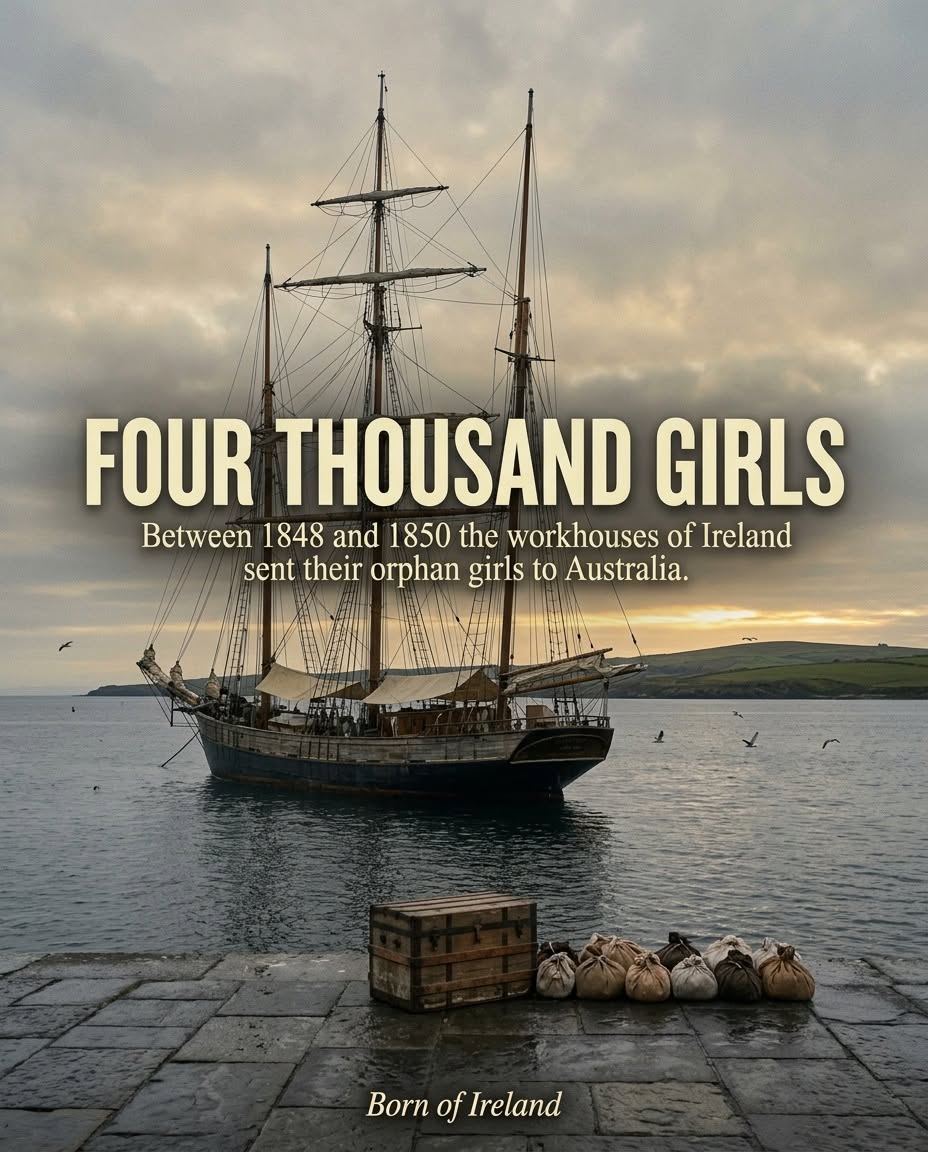
Between 1848 and 1850, four thousand one hundred and fourteen girls were taken out of Irish workhouses and put on ships to Australia. Most of them were between fourteen and twenty. Most had no parents living.
The Earl Grey Scheme solved two problems at once for the authorities. Ireland's workhouses were catastrophically overcrowded, and the Australian colonies had a severe shortage of women, with men outnumbering them by a wide margin.
The girls were selected by the workhouse guardians, given a set of clothes and a wooden trunk, and sent to Plymouth and then across the world on a voyage of about three months. Very few of them ever saw Ireland, or anyone they were related to, again.
They arrived to a reception that was often openly hostile, because sections of the colonial press ran a sustained campaign against them, calling them ignorant and unfit for the colony, and the scheme was cancelled in 1850 partly as a result.
What actually became of them is a different story, since the great majority went into domestic service, married within a few years and had large families, and their descendants are now estimated in the millions across Australia and New Zealand. The records are unusually good, because each girl was listed with her name, age, native place, parents where known and often her religion and literacy, which means an Australian family can frequently trace back to a specific Irish parish through a fourteen year old girl who left it.
There is a memorial at the Hyde Park Barracks in Sydney with many of their names inscribed on it, and it is one of the very few famine monuments anywhere that names individuals rather than numbers. They were sent away as a surplus and became the founding mothers of a country.