

Photographs and Genealogy
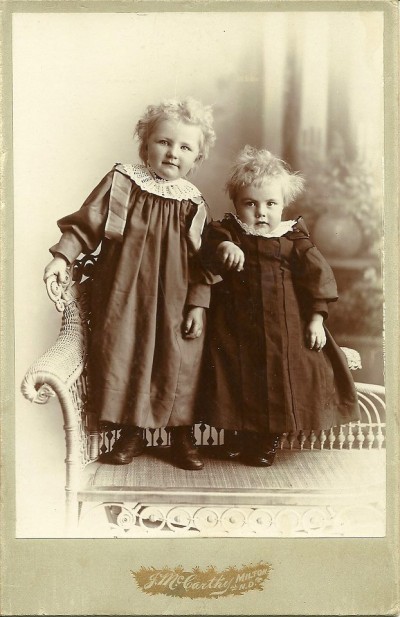 by an Irish photographer, J. McCarthy of Milton, ND. With nothing written on the back, that's about all a modern Norwegian family knew when they recently found the photo. They were ultimately able to figure out a logical American family of origin and send a copy of the delightful photo to distant relatives in the U.S. All copies of the picture on this side of the Atlantic had disappeared, and no one here had ever seen it before.
According to one of those relatives, the little North Dakota Norwegians are Minnie Ottem, born in 1894, and Gudrun Ottem, born in 1897. Little Gudrun looks like she is ready to take on the world. She became a realtor in San Gabriel, California and wore heels until she was almost 90. Their nieces and nephews were happy to see the picture of Minnie and Gudrun as children.
My husband and I have boxes of similarly-unlabeled photographs. I've spent hours gazing at family pictures, trying to will them to disclose their secrets. How much time would have been saved if our ancestors had at least given us hints about who was pictured!
Blogger Deborah Large Fox recently posted some good advice about photos. Highlights are shown below: (Thanks, Deborah!)
"Most people fail to label photographs with sufficient information...A conscientious family historian should follow the "5 W's" in labeling every photo: who, what, when, where, and why. (Use a soft pencil to write on the back of the photo. If you are naming photos on a computer, be as descriptive as possible; most naming fields have plenty of space.)
1. Who? Full names of each person in the photo are necessary. I might know who "Aunt Em" is, but future generations won't know who "Em" was or whose aunt she might have been. Don't forget maiden names of married females. Don't use nicknames exclusively, although it is a good idea to include them in parenthesis with the person's proper name.
2. What? What is the subject of the photo? As family historians, we tend to focus on the names of the people in the photo, but sometimes we have photos of houses, scenery, workplaces, stores, streets, etc. The non-human subjects or background should be identified also. Even with photos of people, it is advisable to ask "what?" Are the people in a group of some kind, for example, "Magee first cousins," "St. John's First Communion Class of 1960,” etc.
3. When? Be as specific as possible with dates. Dates can be crucial clues in genealogical research.
4. Where? Writing "Camden, NJ" is not enough. Again, be as specific as possible: a full street address, a building's name, an intersection, or the address and owner of a backyard (Example: "Jim Large's back yard at 1545 Lees Avenue in Camden, NJ, with Camden City Hall in the distant background far left").
5. Why? Why was the photograph taken? What is the story told by the photo? Do you know a reason why the people in the photo were together? Why they were at the location? Why was Aunt May's photo taken that day? Was a family or individual portrait taken for a special reason? Why is the family standing in front of that building? Why were they at the beach that day? Every picture tells a story--don't forget to include that story."
Thanks again, to Deborah Large Fox and her resource "Mr. B" for their valuable advice. Don't let your family photographs become a descendant's mystery!