


Pheasants in Ireland and South Dakota
Pheasant-hunting is a family tradition for us and a highlight of each year. I haven't kept track but we've probably chased pheasants in my home state at least 20 of the last 25 years. I don't shoot; I flush, point and retrieve. In other words, I'm the bird dog.
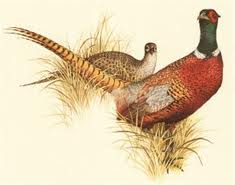
The Chinese ringneck pheasant (Phasiana colchicus) is a beautiful bird. Males have irisdescent plumage in gold and copper, a red face, and a white ring around their green neck. The hen's coloring is more drab enabling it to blend into its habitat. Although the pheasant is the state bird of South Dakota, it's not native. This colorful game bird has been imported from Asia and introduced almost everywhere in the world.
I was surprised to see a pheasant when we were in Ireland. Pheasants were introduced in Ireland by Norman knights, possibly as early as the 12th century, to decorate the castles and be consumed at feasts.
The sporting shotgun didn't appear in Ireland until the early 1800s so pheasants weren't initially intended as game birds. Pheasant-hunting became very popular in Ireland in the 19th and early 20th centuries, especially among the Royals. King George V of England allegedly shot over 1000 birds in one day in 1913!
In South Dakota the limit is three per day per hunter. There's good cover where they can hide, especially early in the season before all the crops are harvested. Pheasants fly 27-38 mph when cruising--faster when they catch a SD tailwind--so the shooter only has a split-second to aim and connect. We always try to get out on the opening weekend, when the young birds are still inexperienced about hunters. They get smart fast.
"Nice story," you say, "but what's that got to do with genealogy?" Well, it turns out there's been a lot of DNA research on pheasants. Most of the scientific studies I found were too complicated for me to follow. Terms like 'genetic distance' and 'genetic polymorphism' made my eyes cross. Mitochondrial DNA sequencing almost sounds like a test to find out if the South Dakota pheasants and the Irish pheasants have a common ancestor - but not!
Interestingly, DNA in pheasants is commonly isolated from their feathers. One study I read on the Internet had to do with survivability of farm-raised pheasants released in the wild, obviously an important factor in wildlife management. Pheasants are big business in South Dakota! We'll be back to blogging about human genealogy next week.