

The Big Easy
Our snowbird trek through the southeastern U.S. will end in a few days, but this week we're hanging out in New Orleans.
We were fortunate Tuesday's tornado missed us here in the French Quarter. That evening we ventured out in the rain for food and music; there are just too many great spots in The Big Easy to skip a night out because of weather. The tornado warnings had caused many businesses to close earlier in the day, but by night most bars and restaurants were hopping busy again.I find several theories about the origin of New Orleans' nickname, "The Big Easy." Certainly the city's an easy place for jazz and blues musicians to find opportunities to play. Another possible origin of the nickname is its relaxed attitude toward alcohol. Many people carry some type of alcoholic libation as they explore the Quarter. Traditionally known for sweet-and-potent "hurricanes," certain Bourbon Street bars now offer a new drink, the "hand grenade."
I won't make any recommendations about food and drink, but I heartily encourage you to visit these New Orleans attractions:
1) The National WWII Museum, #1 attraction in New Orleans and #3 museum in the U.S. According to their brochure, "This must-see attraction transports you to a time when victory hung in the balance. Guaranteed to move and educate..." This visit we spent an entire day in the "Campaigns of Courage" exhibit which vividly describes both the European and Pacific Theaters. One can't help feeling moved by the personal histories and artifacts on display, especially if a family member served during WWII. You can learn more about the museum here: www.nationalww2museum.org/.
2) New Orleans Jazz National Historical Park. Only in New Orleans could there be a National Park for jazz! You can attend a jazz concert or ranger performance at the performing arts venue in the Old U.S. Mint where most performances are free. Check the schedule or listen to past performances at: www.nps.gov/jazz/index.htm. National Park Service (NPS) events are also regularly scheduled in the French Market. That's where we saw and heard "Making a Jazz Gumbo," a live cooking demonstration combined with the music of NPS rangers and other jazz musicians. The demonstration uses live music and a cooking demo to show how gumbo is a perfect metaphor for jazz, and vice versa.
Pictured at right is the cook, Dianne "Gumbo Marie" Honore,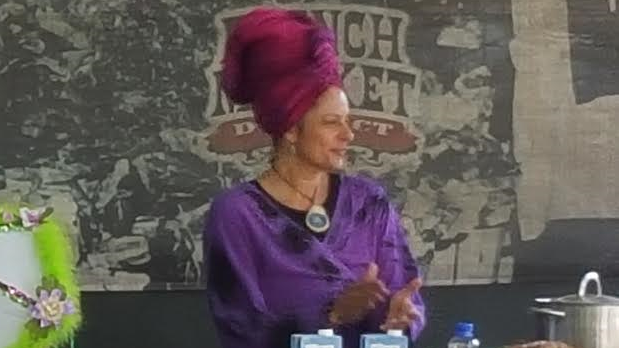 an entertaining story-teller who hails from a long line of Louisiana cooks. Gumbo Marie spoke of her ancestral ties in New Orleans going back to the 1700s. She honors her (7th?) great-grandmother by wearing a tignon, a piece of fabric tied around the head to resemble a turban. During the Spanish colonial period women of color were required to wear tignons in an attempt to maintain class distinctions and keep them from appearing "too white." The creative women used large amounts of material decorated with jewels and ribbons, following the letter of the law while successfully rebelling against its intent.