

The 1766 Religious Census at VRTI
Significant news from the National Archives of Ireland:
Did you know that long before the official census series began in 1813, a massive effort was made to map the people of Ireland?
Authorised by the Irish House of Lords in March 1766, this "census" tasked clergy with listing every family in their parish, distinguishing between Protestant and Roman Catholic households. While many original records were tragically lost in the 1922 Four Courts fire, the surviving fragments remain one of our most precious windows into 18th-century Ireland.
Why does it matter today?
 Genealogy: For those tracing Irish roots, these are some of the earliest records of specific householders and names.
Cultural Insight: It offers a rare snapshot of Irish demographics and religious distribution during the Penal Laws era.
Resilience: Thanks to modern conservation and the Virtual Record Treasury of Ireland, these surviving 59 items from eight counties are now digitized and accessible to everyone.
Find out more about the 1766 Census here: https://nationalarchives.ie/.../religious-census-1766/
MY EXAMPLE:
When I queried "Hickey," I got 61 results!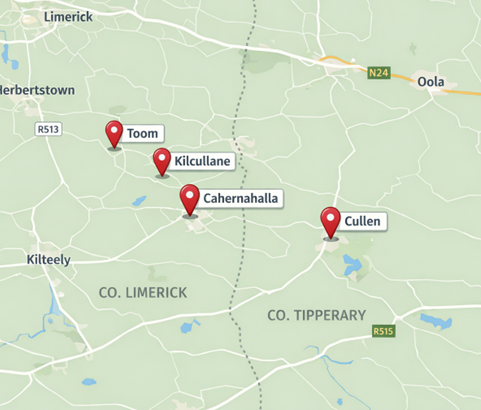
I immediately saw other familiar, related surnames and/or recognized townlands. (My husband Bill's great-grandfather, Patrick Hickey, was born in Cahernahallia, County Tipperary, in 1819.)
I asked ChatGPT to analyze the locations of only three results relative to Cahernahallia. In just a few minutes, the leads were clearly mapped within a 5-mile radius.*
A game changer. This rabbit hole wasn't on my to-do list for today!
*While I think the ChatGPT map is wrong about the exact Limerick/Tipperary border, that's a minor fix.